Midlife Magic
Why is the most powerful consumer in America still being treated like she doesn't exist?
The GenX woman. She controls the wallet. She’s driving culture. She's rewriting what vitality, desire, and joy look like at 45, 50, 55 and beyond. And most brands are still looking right through her.
I'm Kerry Stranman — a brand strategist, GenX woman, and marketing veteran who has spent 30 years helping brands find and express their most powerful human truth. I'm launching Midlife Magic because this consumer is my professional passion and my lived reality. And the gap between what the data says about her and how she's actually treated by brands and culture is a major opportunity.
Edition One — Spring 2026
Why is the most powerful consumer in America still semi-invisible?
The GenX woman. She controls the wallet. She’s driving culture. She's rewriting what vitality, desire, and joy look like at 45, 50, 55 and beyond. And most brands are still looking right through her.
I'm Kerry Stranman — a brand strategist, GenX woman, and marketing veteran who has spent 30 years helping brands find and express their most powerful human truth. I'm launching Midlife Magic because this consumer is my professional passion and my lived reality. And the gap between what the data says about her and how she's actually treated by brands and culture is a major opportunity.
Let's start with the numbers.
She Holds the Wallet
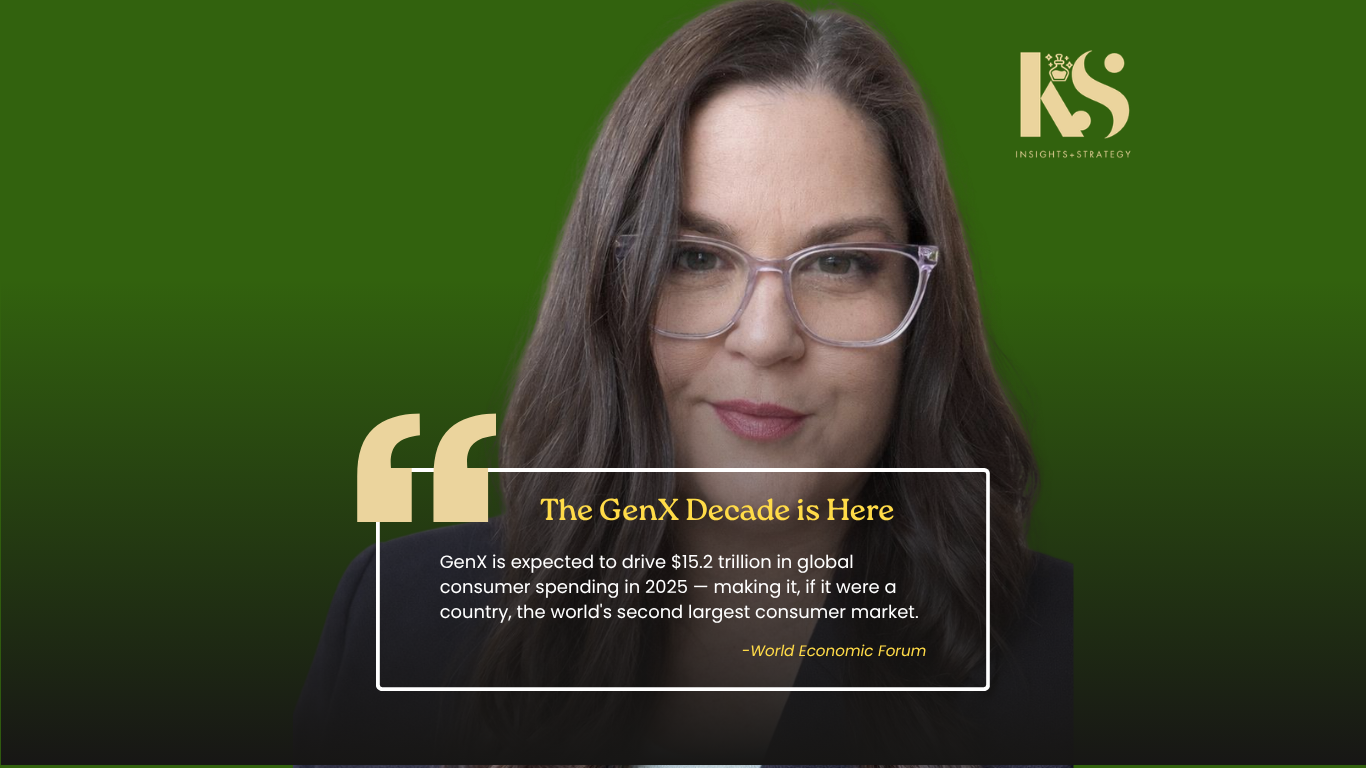
According to the World Economic Forum / NIQ & World Data Lab, GenX is expected to drive $15.2 trillion in global consumer spending in 2025 — making it, if it were a country, the world's second largest consumer market. In beauty alone, Gen X women spend $279 billion annually, projected to grow to $430 billion over the next decade, according to BeautyMatter. These are not niche numbers. We are in the “GenX decade” where this generation leads consumer spending, despite being 18% of the population. This is the most powerful consumer cohort on the planet.
And yet, as the moderator of an Advertising Week New York 2024 panel put it: "We are incredibly powerful, an influential demographic, and yet we are mostly ignored by the broader culture and corporations."
The Cultural Tide Is Finally Turning
Something shifted in 2025 that brand watchers should not miss. Marketing Week said it plainly just this month: culture is finally making room for older women — not as footnotes, not as proof that it's still possible to look good at 50, but as protagonists, in the fullest sense.
GenX women are as relevant as ever. Nicole Kidman and Kate Winslet are commanding screens and culture in their 50s without apology. Naomi Watts launched Stripes, a wellness brand built entirely around the perimenopause experience — because she lived it and couldn't find what she needed. The "pro-aging" GenX woman isn't interested in fighting time. She's interested in owning it. The invisible woman is becoming impossible to ignore. Not in like a Fatal Attraction kind of way. In a finally kind of way.
The question, as Marketing Week rightly asks, is whether brands and their creative teams have noticed.
Her Health Has Been Underfunded. That's Changing Too.
In 2024, the McKinsey Health Institute and the World Economic Forum released landmark research quantifying what many women have known in their bodies for years: women spend 25% more of their lives in poor health than men. Closing that gap could add $1 trillion annually to the global economy by 2040.
And the disparity in investment is staggering. Prior McKinsey analysis found that funding for erectile dysfunction research was six times higher than funding for endometriosis — $1.24 billion compared to $44 million. The menopause treatment market alone represents an untapped opportunity of $120-$230 billion globally per year.
Enter Cindy Eckert.
The Name to Know: Cindy Eckert
In February 2026, TIME named Cindy Eckert — founder and CEO of Sprout Pharmaceuticals — to its TIME100 Health list of the world's most influential leaders shaping the future of health. The honor followed a landmark FDA decision in December 2025 expanding Addyi's approval to include all women under 65, closing a decade-long gap in women's sexual health care.
The New York Times once called Addyi "the drug of a generation." I'd call it something more: proof that when a woman with conviction and commercial instincts decides the market is wrong, she can change it.
Eckert's decade-long fight is now the subject of The Pink Pill: Sex, Drugs & Who Has Control — a documentary that premiered at DOC NYC 2025 and won the Audience Award. It's a hell of a story and you can watch it on Paramount+. She’s a GenX badass, BTW.
The Campaign: Big Pink Energy
I had the privilege of working as the brand positioning and campaign strategist on the new Addyi Big Pink Energy campaign with Near&Dear agency. The key insight: Women are mad as hell that their health care has lagged men for so long. Menopause is having a moment and GenX women are rewriting the playbook, pursuing vital sex lives and vigorous health just like men have for millennia. It’s time for Addyi to make a bold cultural assertion: female libido is a real biological health issue that matters — even after menopause! And yes, women’s libido is biological. Women, prepare to be shocked: brain scans show female desire starts in the brain, not in the loins. If you’ve lost your libido, it’s not just “all in your head”, but it is in your brain. It’s neurochemistry.
The campaign launches with the iconic Shania Twain track, “Man! I Feel Like a Woman”, as a swaggy rallying cry to women. “Let’s GO!O!O!O!O!O!O!O!”
The Magic: Claim Your Desire
Cindy Eckert has a rallying cry: claim your desire. It's the animating force behind Addyi and behind her decade-long fight to make women's sexual health a legitimate medical priority — not a punchline, not a luxury, not an afterthought.
I'd argue it's also the animating force behind every midlife woman who has ever done something purely because it lit her up inside.
For me, that thing has been comedy. I started writing and performing comedy as a recovery balm after two decades of ad agency life led to some serious burnout. Because when you think about escaping the hustle and grind, you think, LA comedy scene. I didn’t do it because it made logical sense, but because my soul demanded it. My soul can be really annoying like that. Desire isn’t just sexual. It's that force that pulls you toward your most alive self.
Now What? Cosmic Fairy Tales of Midlife in Los Angeles is a series of short comedic stories about following that force inside that demands moments of big, wild joy — one improbable, joyful chapter at a time. Think David Sedaris meets midlife LA, with a side of burlesque. What could happen if you tried life on the soul line instead of the goal line, at least some of the time? Find out on Spotify.
You have a right to desire, and that can be in the bedroom, the board room, or whatever place you want." Cindy Eckert , CEO and Founder, Sprout Pharmaceuticals
The Moment
$15.2 trillion. The GenX decade is here. Is your brand paying attention?
Midlife Magic is a quarterly dispatch on the most underestimated consumer in America — the GenX and midlife woman, her spending power, her cultural ascendance, and the brands finally getting it right. From Kerry Stranman, Brand Alchemist and proud GenXer. kerrystranman.com